

Is A Nut One Grade Lower Than A Bolt Safer?
There is a misconception that it is safer to choose a nut one grade lower than the bolt to make the nut fail before the bolt and thus be more easily detected. However, whether the nut is safer than the bolt at a lower level needs to be comprehensively judged according to the specific application scenario and safety requirements.
In some cases with high safety requirements, if the nut is one grade lower than the bolt, the reliability of the connection may be reduced. For example, in areas such as aerospace or heavy machinery, where the safety and stability of connections are extremely high, nut and bolt grades need to be precisely matched, and even higher nut grades may be required to ensure that the connection remains stable under a variety of complex operating conditions.
Under normal circumstances, the performance grade of the nut should not be lower than the performance grade of the bolt that matches it, but it should not be too high to avoid wasting resources.
In mechanical connections, the grade matching of nuts and bolts must follow certain principles to ensure reliability and safety. As a professional fastener manufacturer, Xinchi is happy to give you a specific analysis of these principles.
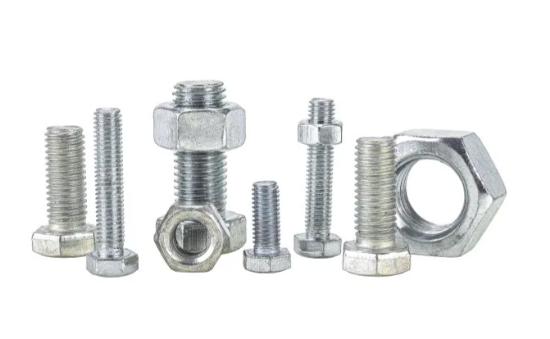
The grade matching principle of nuts and bolts
Equal strength principle: It is generally recommended that nuts and bolts have the same strength level (such as 8.8 bolts and 8.8 nuts) to ensure the same bearing capacity and avoid thread shear or slip due to strength differences.
Exceptions for nuts with a lower grade: If the nut material has good toughness (such as stainless steel nuts), the nut grade can be slightly lower than the bolt (such as 8.8 bolts with 6 nuts) under static load and low vibration scenarios, provided that the following conditions are met:
The Proof Load of the nut is not less than 70% of the tensile strength of the bolt;
Need to pass the actual working condition verification (such as vibration test).
The potential risk of low-grade nuts
Thread failure risk: If the nut is significantly less strong than the bolt, in high preload or vibration scenarios, the nut thread may undergo plastic deformation or shear failure before the bolt.
Hidden danger of connection loosening: The anti-relaxation performance of low-grade nuts is weak, and long-term vibration easily causes the preload to decrease, resulting in the loosening of the connection.
Practical operation suggestions for bolt and nut connection
If it is a general mechanical connection, it is recommended that the bolt and nut be of the same grade (such as 8.8 with 8.8) to ensure balanced strength.
In the case of a high vibration or impact environment, it is recommended that the nut grade be no lower than the bolt, and the lock nut (such as a nylon insert) is preferred.
If it is a special combination of materials, it is recommended to convert equivalent grades according to material strength, such as stainless steel A2-70 ≈ carbon steel 5.6.
A nut one grade lower than a bolt is not generally safer. In most working conditions, it is recommended that nuts and bolts be of the same grade. In special scenarios, if the nut grade needs to be reduced, its bearing capacity and fatigue resistance must be strictly verified. The matching suggestions of standards (such as ISO 898, GB/T 3098) are preferred during design.
XINCHI is a trustworthy fastener company, especially in furniture nuts. We have a factory, founded in 2007. We are the designated fastener supplier to“STAPLE”. As a trusted fastener supplier, XINCHI can offer a wide range of high-quality fasteners, including nuts, screws, bolts, rivets, washers, etc. If you want to know more about fasteners or want to wholesale fasteners, please feel free to contact us. Our experienced and expert service team will reply to you as soon as possible.