

Different Types of Hopper Feed T Nuts: M6, M8, and More
Hopper Feed T Nuts are widely used in automated assembly lines where speed, consistency, and reliable fastening are critical. Compared with manual-fed T nuts, hopper-fed T nuts are designed for bulk feeding systems, improving installation efficiency and reducing labor costs.
As a professional t-nut manufacturer, Xinchi is willing to introduce the differences between common sizes, materials, and application scenarios of hopper feed T-nut.
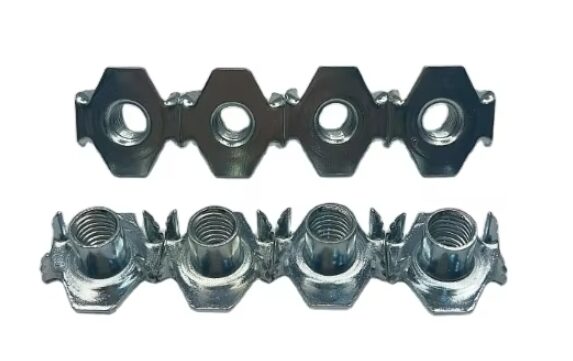
Common Hopper Feed T Nut Sizes: M6, M8, and Other Specifications
Among various specifications, M6 hopper feed T nuts and M8 hopper feed T nuts are the most commonly used sizes in industrial production. M6 hopper feed T nuts are typically applied in light to medium-duty assemblies, such as furniture components, sheet metal parts, and light mechanical structures. Their compact size makes them suitable for applications where space is limited but stable fastening is still required.
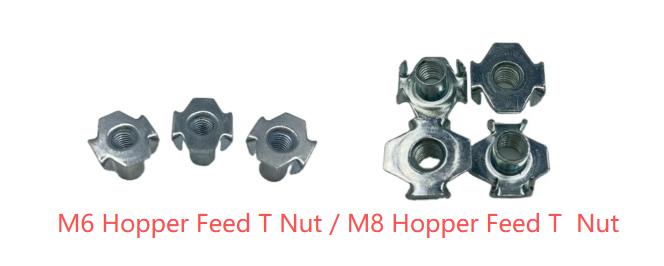
M6 M8 Hopper Feed T Nut
In contrast, M8 hopper feed T nuts are often chosen for higher load-bearing requirements. They are widely used in machinery frames, industrial equipment, and structural assemblies where a stronger clamping force is necessary. Beyond M6 and M8, hopper feed T nuts are also available in other metric sizes to match different bolt diameters and application needs, ensuring compatibility with automated feeding and installation systems.
Hopper Feed T Nut Material Options: Carbon Steel vs Stainless Steel
Material selection plays a key role in the performance and service life of a hopper feed T nut. Carbon steel hopper feed T nuts are the most cost-effective option and are commonly used in indoor or dry environments. With appropriate surface treatments such as zinc plating, carbon steel T nuts provide good strength and wear resistance for general industrial applications.
For environments requiring higher corrosion resistance, stainless steel hopper feed T nuts are a better choice. Stainless steel materials offer excellent resistance to moisture, chemicals, and temperature changes, making them suitable for outdoor use, humid environments, or applications with strict hygiene requirements. Although stainless steel hopper feed T nuts come at a higher cost, they provide longer service life and reduced maintenance in demanding conditions.
Hopper Feed T Nut Application Scenarios and Performance Comparison
Different types of hopper feed T nuts are designed to meet specific application demands. In furniture manufacturing and automated assembly lines, M6 hopper feed T nuts made from carbon steel are often preferred due to their balance of strength and cost efficiency. They work well with high-speed feeding systems and provide consistent installation results.
In heavy-duty machinery and industrial equipment, M8 hopper feed T nuts offer improved load capacity and fastening stability. When used in corrosive or outdoor environments, stainless steel hopper feed T nuts ensure reliable performance over time. By matching the correct size and material to the application scenario, manufacturers can improve assembly efficiency, reduce failure rates, and extend product lifespan.
Why Choose Xinchi as Your Hopper Feed T Nut Manufacturer
Xinchi Fasteners has specialized in fastener manufacturing since 2007, focusing on stable quality and large-scale production capacity. The factory operates a total of 102 cold heading machines, with a daily output exceeding 10 million pieces, ensuring a reliable supply for bulk orders of hopper feed T nuts.

Xinchi Fastener Factory
Xinchi’s newly completed factory covers an area of 30,000 square meters and includes two six-story production buildings, supporting efficient production management and strict quality control. As a trusted fastener supplier, we offer a wide range of high-quality fasteners, including nuts, screws, bolts, rivets, and washers. With experience in manufacturing M6 and M8 hopper feed T nuts as well as other specifications, Xinchi provides consistent products suitable for automated feeding systems and long-term industrial use.
Recent Comments