

Analysis Of Common Causes Of Bolt Breakage-Stress Factor
There are various reasons for bolt breakage of fasteners. Generally speaking, bolt damage is caused by stress factor, fatigue, corrosion and hydrogen embrittlement. As a professional fastener manufacturer, Xinchi Fastener Company is pleased to introduce you one by one.
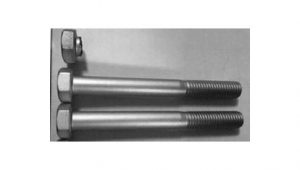
Bolt Breakage
Let’s start with the stress factor.
Excess stress (overstress) is caused by any or a combination of shear, tensile, bending, and compression.
Most designers first consider the combination of tensile load, preload, and additional utility load. The preload force is basically internal and static, which compresses the engaged assembly. Practical loads are external, generally cyclic (reciprocating) forces applied to the fastener.
Tensile load attempts to open the engaged assembly. When these loads exceed the yield limit of the bolt, the bolt changes from an elastic deformation to a plastic zone, resulting in permanent deformation of the bolt, so that it cannot be restored to its original state when the external load is removed. For similar reasons, if the external load on the bolt exceeds its ultimate tensile strength, the bolt will break.
The tightening of bolts is obtained by torsion of the pre-tightening force. During installation, excessive torque leads to overtorque, which also causes the fastener to be overstressed and reduces the axial tensile strength of the fastener. That is, the yield value of the bolts in continuous torsion is lower than that of the same bolts directly under tension. In this case, the bolt may yield at less than the minimum tensile strength of the corresponding standard. Large torsional torque can increase the bolt preload and reduce the joint relaxation. In order to increase the locking force, the preload is generally taken to the upper limit. In this way, the bolt will not yield due to torsion unless the difference between yield strength and ultimate tensile strength is very small.
Shear load exerts a vertical force on the longitudinal axis of the bolt. Shear stress can be divided into single shear stress and double shear stress. From the empirical data, the ultimate shear stress is about 65% of the ultimate tensile stress. Shear loads are preferred by many designers because they take advantage of the tensile and shear strength of the bolt. Shear loads act primarily like pins, allowing fasteners to form relatively simple connections under shear.The disadvantages are that the clipping join is small in scope and cannot be used often because it requires more material and space. We know that material composition and precision also play a role. However, material data for translating tensile stress into shear load are often unavailable.
The preload of a fastener affects the integrity of the shear joint. The lower the preload, the easier it is to slip the bonding layer when in contact with the bolt. Shear load capacity is calculated by multiplying the number of transverse planes (one shear plane is known as single shear and two shear planes are known as double shear), which should be the cross section of the unthreaded bolt. Shear through thread design is not advocated because the shear strength of the fastener can be overcome by stress concentration as the cross section changes. When evaluating the shear strength of fasteners, some designers use tensile stress areas, while others prefer small diameter sections. If the bolt in the shear joint is twisted to the specified value, the mating surface of the contact layer shall not start sliding until it exceeds the friction resistance outside. Increasing friction between mating surfaces can improve the integrity of the joint. Sometimes the number of bolts must be limited due to part size and design requirements.
In addition to tensile and shear loads, bending stress is another load the bolt is subjected to. It is caused by external forces at the bearing and mating surfaces that are not perpendicular to the longitudinal axis of the bolt. In addition to tensile and shear loads, bending stress is another load borne by bolts. It is caused by external forces on bearings and mating surfaces that are not perpendicular to the longitudinal axis of the bolt. On the whole, the simpler the fastener connection, the greater its integrity and reliability.
Xinchi Fastener Company is a trustworthy fastener company, especially in furniture nuts. And we are the designated fastener supplier to“STAPLE”. As a trusted fastener supplier, Xinchi Fastener Company can offer a wide range of high-quality fasteners, including tee nuts, screws, bolts, rivets, washers, etc. If you want to know more about fasteners or want to wholesale fasteners, please feel free to contact us. And then our experienced and expert service team will reply to you as soon as possible.