

How to Judge Rivet Nut Quality: A Practical Guide for Buyers and Engineers
Choosing a reliable rivet nut (also known as a blind rivet nut) directly affects joint strength, assembly efficiency, and long-term stability. While low-quality rivet nuts may look acceptable at first glance, problems often appear during installation or actual use.
To accurately evaluate rivet nut quality, it is important to consider appearance, material, installation performance, and real application behavior together—not just one factor. As a professional rivet nut manufacturer, Xinchi is glad to share how to judge rivet nut quality.
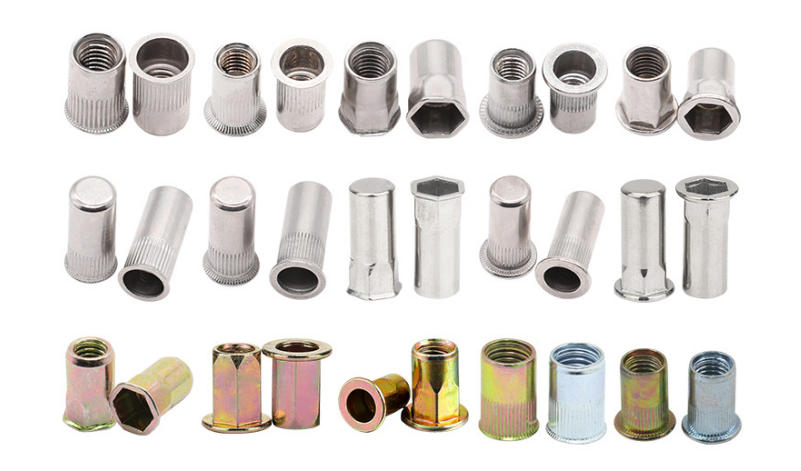
rivet nut
Rivet Nut Appearance and Basic Dimensional Quality
The first impression of a rivet nut often reveals early quality signals. A well-made blind rivet nut shows clean, complete internal threads with consistent tooth shape. When a bolt is screwed in, it should feel smooth and stable, without abnormal resistance or looseness.
In addition, the outer body and flange of the rivet nut should be evenly formed. Surface scratches, folding marks, or distorted flanges often indicate unstable forming processes, which may lead to unpredictable deformation during installation.
Surface finishing also matters. Whether zinc-plated, nickel-plated, or stainless steel, a high-quality rivet nut should have a uniform coating and good adhesion, ensuring proper corrosion resistance in real working environments.
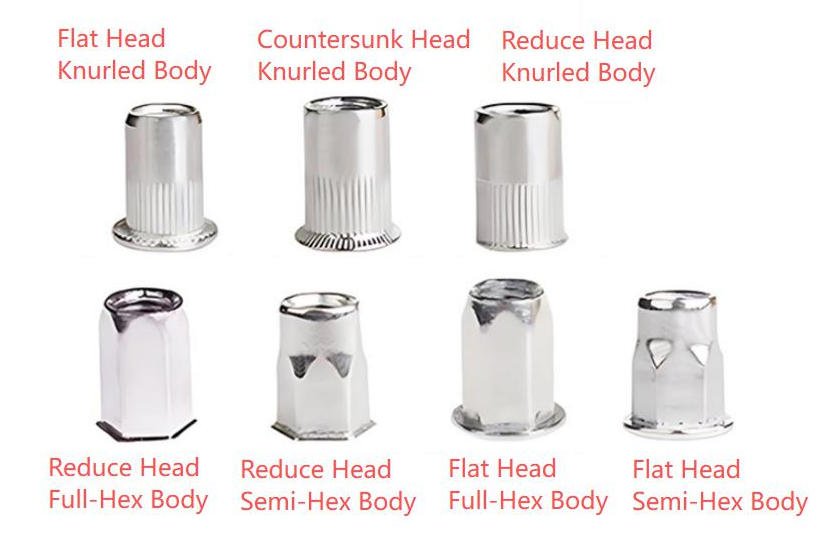
rivet nut
Rivet Nut Material Selection and Hardness Balance
Material choice is a core factor in rivet nut performance. Common rivet nut materials include carbon steel, stainless steel, and aluminum alloy, each suitable for different load and environment requirements.
A quality blind rivet nut must achieve the right balance between strength and ductility. If the material is too soft, the rivet nut may spin or lose holding force after installation. If it is too hard, cracking or incomplete deformation may occur during the riveting process.
A properly engineered rivet nut deforms evenly during installation while maintaining sufficient thread strength after setting.
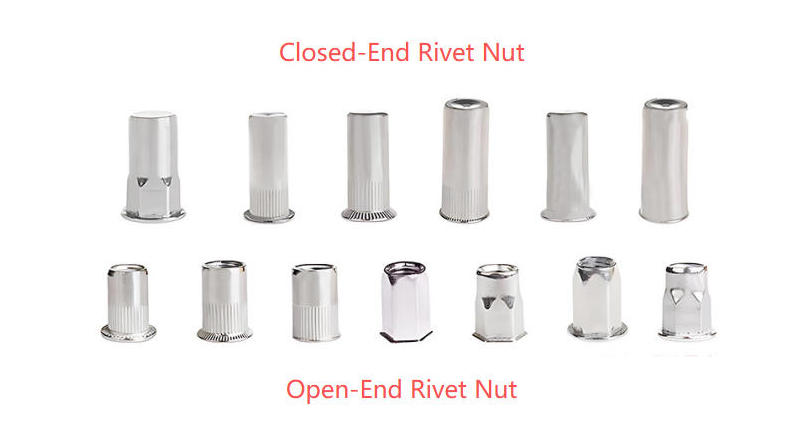
closed-end & open-end rivet nuts
Rivet Nut Installation Performance and Deformation Behavior
The installation process is one of the most reliable ways to judge rivet nut quality. Under correct hole size and with proper installation tools, a good rivet nut sets smoothly and predictably, without sudden loss of resistance or abnormal force spikes.
After installation, the backside expansion zone of the blind rivet nut should be symmetrical and tightly clamped against the base material. Uneven bulging, localized collapse, or visible cracking usually signals material or forming issues that may compromise long-term performance.
Another key indicator is rotation resistance. Once installed, a quality rivet nut should remain firmly locked in place when tightening the bolt within the recommended torque range.
Rivet Nut Performance in Real Applications
In actual use, a high-quality rivet nut should consistently withstand axial pull forces and tightening torque without loosening. It should maintain stable performance under vibration, repeated assembly, and long-term service conditions.
Thread durability is also important. After multiple bolt installations and removals, the internal threads of a reliable rivet nut remain intact, without stripping or deformation. Poor-quality rivet nuts often fail early during repeated use, leading to maintenance issues or safety risks.
Evaluating Rivet Nut Quality from the Manufacturer’s Capability
Beyond the product itself, the manufacturer’s capability provides valuable insight into rivet nut quality consistency. Stable production processes, controlled tolerances, and routine testing—such as pull-out strength and torque resistance—are critical for reliable blind rivet nut supply.
Manufacturers with long-term experience and large-scale cold heading capacity tend to deliver rivet nuts with better dimensional accuracy and batch consistency, reducing risk for downstream assembly.
Xinchi Fastener Factory Advantages
Xinchi Fasteners has been specializing in fastener manufacturing since 2007, focusing on reliable and scalable production of rivet nuts and other fastening solutions. The factory operates 102 cold heading machines, with a daily output exceeding 10 million pieces, ensuring a stable supply for both standard and customized rivet nut requirements.

Xinchi Fastener Factory
Xinchi’s newly completed factory covers 30,000 square meters, consisting of two six-floor production buildings, supporting efficient manufacturing, quality control, and logistics. As a trusted fastener supplier, Xinchi offers a wide range of high-quality fasteners, including nuts, screws, bolts, rivets, and washers. With mature production experience and strict process management, Xinchi provides consistent-quality rivet nuts suitable for global industrial applications.