

Four-Prong T-Nuts vs. Other T-Nuts: Structure, Applications, and Performance
T nuts are widely used in woodworking, furniture production, and industrial fastening applications. Among them, Four-Prong T-Nuts stand out due to their superior grip and stability. In this article, we’ll compare Four-Prong T-nuts with Two-Prong and Three-Prong T-nuts, as well as with Weld Nuts and Threaded Insert Nuts, highlighting key differences in structure, function, and usage. We’ll also introduce the manufacturing capabilities of XINCHI, one of China’s leading T-nut factories.
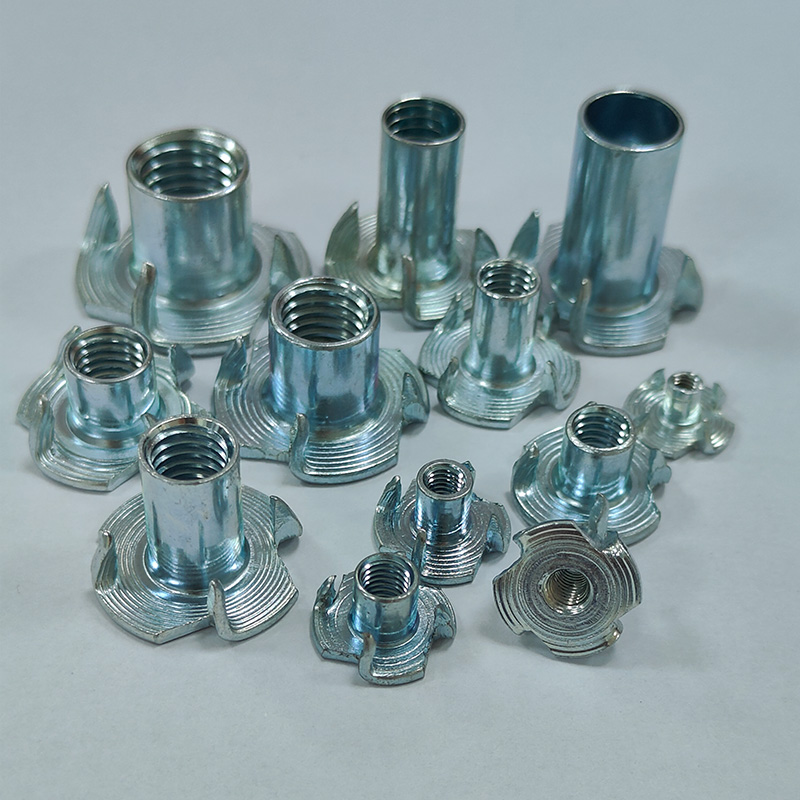
4 Prong T-nuts
Four-Prong T-Nuts: Stable, Secure, and Widely Compatible
Four-Prong T-Nuts are designed for use in wood, plywood, MDF, and other soft base materials. They feature a T-shaped flange with four sharp prongs that are hammered or pressed into the substrate to form a strong and secure thread.
Key Advantages:
- Four prongs provide maximum anti-rotation performance and firm grip
- Fast installation for high-volume furniture or woodworking production
- Standard choice for a variety of structural joints
XINCHI Factory Advantages:
We operate 102 cold-forging machines with a daily output exceeding 10 million pieces. Our new facility covers 30,000 square meters, featuring two six-story production buildings with a streamlined layout and efficient workflow.
Two-Prong & Three-Prong T-Nuts: Cost-Effective Options for Light-Duty Use
While Two-Prong and Three-Prong T-Nuts share a similar design, their reduced number of prongs offers less grip and rotational stability compared to Four-Prong types.
| Type | Stability | Ease of Installation | Recommended Use |
| Two-Prong | Low | Very easy | Light-duty, confined space |
| Three-Prong | Medium | Moderate | Mid-load applications |
| Four-Prong | High | Slightly more complex | Standard/high-load furniture |
Conclusion: For budget-sensitive or compact-space applications, two- or three-prong nuts are acceptable. However, for most structural furniture joints, Four-Prong T-Nuts remain the most reliable and professional choice.
Weld Nuts vs. Four-Prong T-Nuts: Material and Mounting Differences
Weld Nuts are designed for metal-to-metal connections, requiring welding for installation.
| Comparison | Four-Prong T-Nut | Weld Nut |
| Mounting | Hammer/press into soft material | Weld to metal surface |
| Base Material | Wood, MDF, composites | Steel, stainless steel |
| Installation | Simple and fast | Requires skilled welding |
| Cost | Low, mass production-friendly | Higher due to labor & equipment |
Weld Nuts are ideal for industrial machinery and automotive parts, whereas Four-Prong T-nuts are better suited for wooden structures and furniture manufacturing.
Threaded Insert Nuts vs. Four-Prong T-Nuts: Aesthetic and Reusability Focus
Threaded Insert Nuts (also known as thread inserts) are embedded into a predrilled hole or melted into plastic/wood substrates. They are popular in high-end applications where reusability and appearance are critical.
| Comparison | Four-Prong T-Nut | Threaded Insert Nut |
| Appearance | Exposed flange | Hidden, cleaner look |
| Reusability | Moderate | Excellent for repeated assembly/disassembly |
| Installation | Press/hammer | Screw-in or heat-insert |
| Applications | Furniture, display racks | Premium furniture, DIY, electronics casings |
Conclusion: Insert nuts are preferable if the project demands clean aesthetics and frequent part replacement. But for efficient mass production and strong mechanical hold, Four-Prong T-nuts remain the optimal choice.
Why Choose XINCHI as Your T-Nut Supplier?
At XINCHI, we manufacture a complete range of T-nuts, including Four-Prong, Three-Prong, Two-Prong, Weld Nuts, and Insert Nuts — and we back our products with industrial-grade production power:
- Cold Forging Capacity: 102 high-speed machines producing 10+ million pcs/day
- Facility Scale: 30,000 m² factory with two six-floor production blocks
- Custom Capability: OEM & ODM available; rapid prototyping support
- Global Reach: Exporting to Europe, the US, Eastern Europe, the Middle East, etc.
- Fast Turnaround: Stable lead time and flexible production scheduling
With their secure grip and reliable structure, Four-Prong T-Nuts continue to be a go-to solution in global fastening systems. By understanding the key differences between various T-nuts and fasteners, you can make informed purchasing decisions based on your material, installation method, and end-use.
Interested in bulk pricing, OEM support, or free samples? Contact XINCHI today and let’s build your supply chain together.
XINCHI is a trustworthy fastener company, especially in furniture nuts. We have a factory, founded in 2007. We are the designated fastener supplier to“STAPLE”. As a trusted fastener supplier, XINCHI can offer a wide range of high-quality fasteners, including nuts, screws, bolts, rivets, washers, etc. If you want to know more about fasteners or want to wholesale fasteners, please feel free to contact us. Our experienced and expert service team will reply as soon as possible.
Recent Comments