

Common Misconceptions About Hopper Feed T Nuts: Correct Installation and Practical Tips
In furniture hardware, wooden structures, and panel assemblies, Hopper Feed T Nuts are widely used to provide strong internal threads in wood or composite boards. However, in real production and installation scenarios, many problems do not come from the product itself — they come from misuse.
As a professional fastener manufacturer, we often see incorrect installation methods, such as forcing the nut into undersized holes or selecting the wrong thread specification. These small mistakes can lead to loose connections, damaged boards, or even product failure. This article focuses on common misconceptions about Hopper Feed T Nuts, proper installation methods, and important precautions to ensure reliable performance.
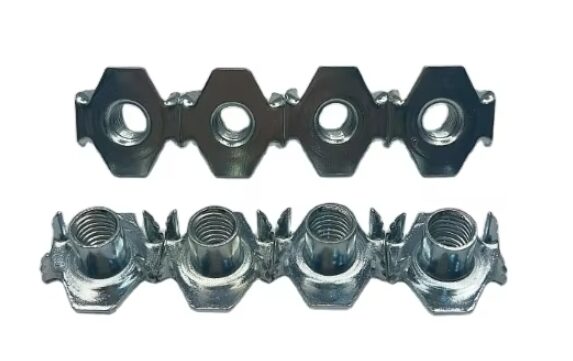
Hopper Feed T Nuts
Product Overview of Hopper Feed T Nuts
Before discussing common mistakes, it is important to clearly understand what a Hopper Feed T Nut is and how it works.
A Hopper Feed T Nut is a type of T-shaped threaded insert designed for automated feeding systems. It is typically installed into pre-drilled holes in wood, plywood, or MDF boards, creating a durable metal thread inside the material. The prongs on the flange bite into the wood surface, preventing rotation when bolts are tightened.
Compared with standard T nuts, Hopper Feed T Nuts are optimized for automatic installation equipment, making them suitable for high-volume furniture and hardware production lines.
Specification of Hopper Feed T Nuts
One common misconception is that all T nuts are interchangeable. In reality, choosing the correct Hopper Feed T Nut specification is critical.
Thread sizes commonly include M6, M8, and other metric dimensions. The barrel length must match the board thickness. If the barrel is too short, the holding strength decreases. If it is too long, it may penetrate the opposite surface.
Hole diameter is another key factor. The pre-drilled hole must match the outer diameter of the barrel. An oversized hole reduces pull-out strength, while an undersized hole leads to installation damage.
Correct specification selection directly affects load-bearing capacity and long-term reliability.
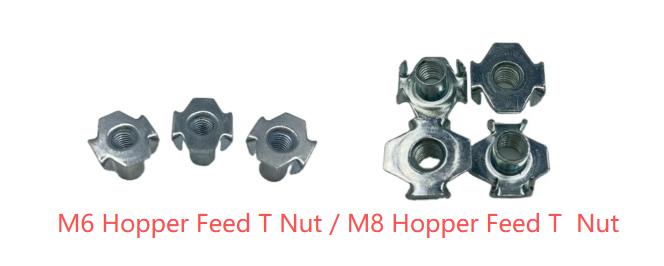
M6 M8 Hopper Feed T Nut
Features of Hopper Feed T Nuts in Automated Production
The design of Hopper Feed T Nuts makes them especially suitable for automated hopper feeding systems. Their shape allows smooth alignment and stable insertion during mass production.
The prongs are engineered to anchor firmly into wooden materials without excessive splitting. High-quality carbon steel materials and surface treatments, such as zinc plating improve corrosion resistance.
However, these advantages only work properly when the nuts are installed under correct conditions. Even a well-designed Hopper Feed T Nut cannot compensate for incorrect hole preparation or improper force application.
Common Misconceptions About Hopper Feed T Nut Installation
In daily production, several installation errors appear frequently.
The first mistake is forcing the Hopper Feed T Nut into an undersized hole. Some operators assume that tighter is stronger. In fact, excessive force may deform the barrel or damage the prongs, reducing grip strength.
Another common issue is hammering the nut aggressively. While light tapping may be acceptable in manual installation, heavy impact can cause flange distortion or cracking in MDF boards.
Choosing the wrong thread specification is also a serious problem. Using an M8 bolt in a poorly matched M8 Hopper Feed T Nut — especially when thread tolerance is incorrect — can result in cross-threading or premature wear.
In some cases, installers ignore board density. Softwood, plywood, and particle board have different holding characteristics. Using the same installation parameters for all materials often leads to inconsistent performance.
These mistakes do not usually show immediate failure, but they reduce long-term structural stability.
Correct Installation Method for Hopper Feed T Nuts
Proper installation begins with accurate drilling. The hole diameter must follow the Hopper Feed T Nut specification provided by the manufacturer. Clean edges and perpendicular drilling help ensure alignment.
For manual installation, apply steady pressure rather than excessive hammering. In automated production, adjust machine force to prevent over-compression.
Ensure the flange sits flush against the board surface. If gaps remain, bolt tightening may pull the nut deeper and damage the board fibers.
When higher load strength is required, consider selecting longer barrel types or reinforced prong designs rather than increasing installation force.
Correct installation is not complicated, but it requires attention to detail.
Advantages of Properly Installed Hopper Feed T Nuts
When installed correctly, Hopper Feed T Nuts provide strong internal threading, excellent anti-rotation performance, and stable load distribution.
They allow repeated bolt assembly and disassembly without damaging the wooden substrate. In furniture and structural components, this reliability reduces after-sales complaints and improves overall product quality.
Proper installation also increases production efficiency by minimizing rework and material waste.
Application of Hopper Feed T Nuts
Hopper Feed T Nuts are commonly used in furniture manufacturing, cabinet structures, wooden frames, and industrial wood assemblies.
In automated furniture production lines, they are especially valued for compatibility with hopper feeding systems. They are also suitable for applications where bolts need to be removed and reinstalled multiple times.
When correctly selected and installed, Hopper Feed T Nuts perform reliably across a wide range of wood-based materials.
Why Choose Xinchi Fastener Factory
Xinchi Fastener Factory has focused on fastener manufacturing since 2007. We operate 102 cold heading machines, with a daily production capacity exceeding 10 million pieces. Our newly completed factory covers 30,000 square meters, including two six-story buildings designed for large-scale and stable production.
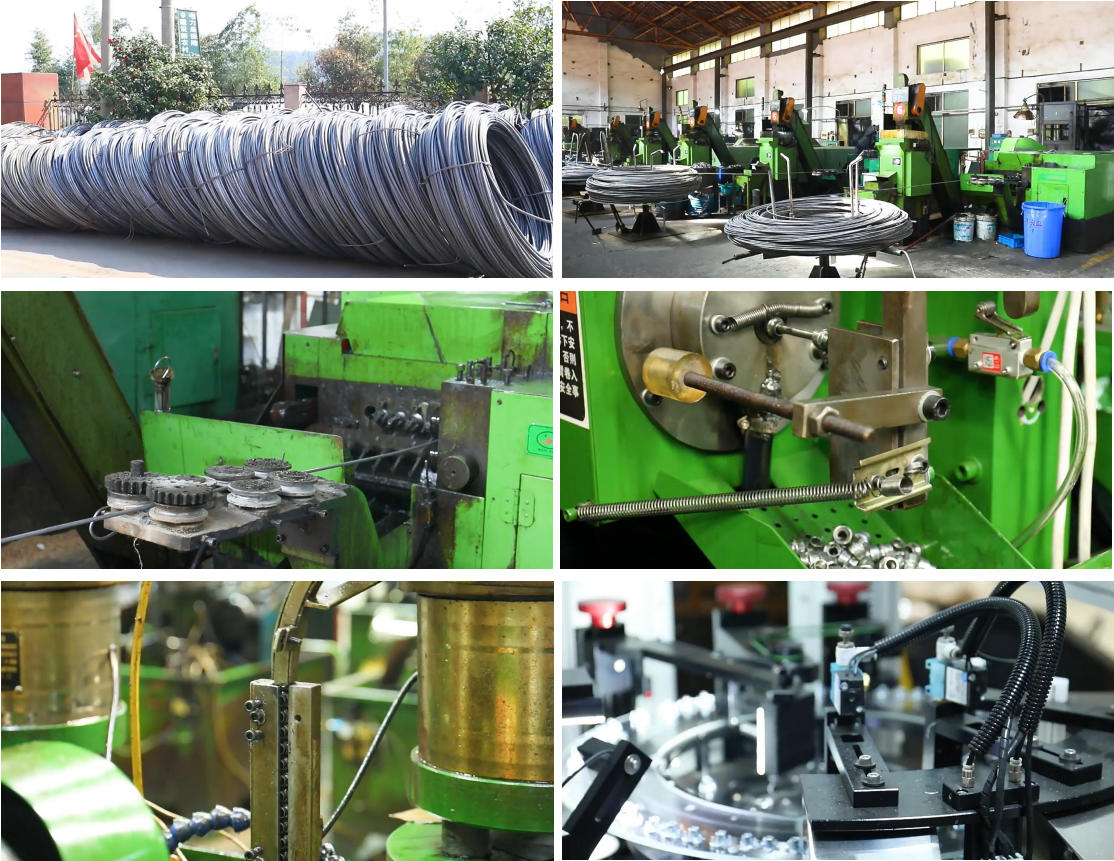
Xinchi Fastener Factory
We specialize in various fasteners, including Hopper Feed T Nuts, ensuring consistent dimensional accuracy and reliable mechanical performance. As a trusted fastener supplier, we offer a wide range of high-quality fasteners, including nuts, screws, bolts, rivets, and washers. With strong production capacity and strict quality control, we support both automated production and customized fastener requirements.
If you are looking for a stable supplier of Hopper Feed T Nuts with reliable quality and scalable production, Xinchi Fastener Factory is ready to support your business.
Recent Comments