

Common Mistakes When Using Hopper Feed T Nuts
Hopper Feed T Nuts are widely used in automated fastening systems because of their efficiency and consistency. However, in real production environments, small mistakes during application can easily lead to quality issues, assembly failure, or production delays.
As a professional T-Nut manufacturer, Xinchi Fasteners is glad to share some problems, hoping it could help improve both efficiency and product reliability.
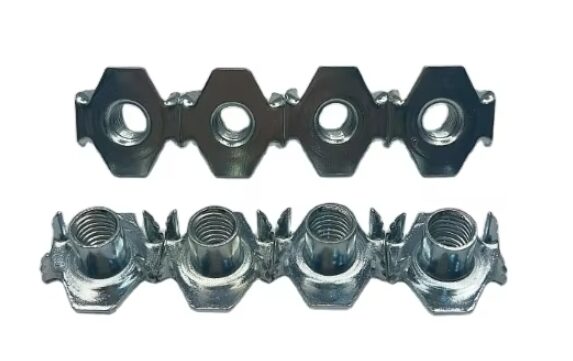
hopper feed T- nuts
Incorrect Hole Size When Installing Hopper Feed T Nuts
When working with Hopper Feed T Nuts, one of the most common problems comes from improper hole sizing. In real applications, operators sometimes overlook the importance of precise machining, which leads to either oversized or undersized holes.
If the hole is too large, the Hopper Feed T Nut cannot lock properly, which may result in slipping or stripped threads during tightening. If the hole is too small, installation becomes difficult and may damage both the nut and the workpiece. In practical production, maintaining correct tolerances is essential to ensure the stable performance of Hopper Feed T Nuts in assembly lines.
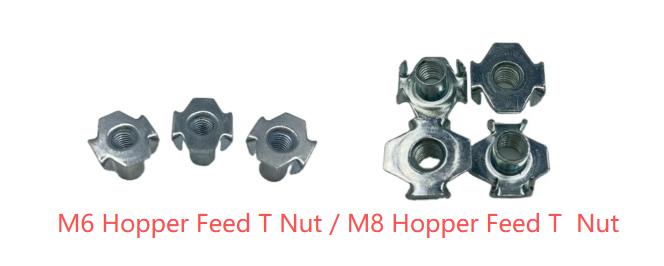
M6 & M8 Hopper Feed T Nut
Feeding Issues in Hopper Feed T Nuts Automatic Systems
In automated production, Hopper Feed T Nuts rely heavily on smooth feeding systems. However, many factories encounter issues such as jamming, misalignment, or inconsistent feeding speed during operation.
These problems are often caused by dust, improper hopper adjustment, or slight deformation of the Hopper Feed T Nuts during storage or transport. When feeding is not stable, the entire assembly line can slow down or stop. In practice, keeping the hopper clean and ensuring consistent nut orientation helps maintain stable performance and improve overall production efficiency.

M8 large base hopper feed T-nut
Material Mismatch Problems with Hopper Feed T Nuts
Another issue that often appears in production is the mismatch between Hopper Feed T Nuts and the workpiece material. Different materials require different levels of hardness and friction performance, and ignoring this can affect the final connection strength.
For example, using a harder Hopper Feed T Nut on a softer material may cause deformation or surface damage, while a softer nut may not provide enough holding strength on harder substrates. In real manufacturing scenarios, selecting the correct material combination is essential to ensure both durability and secure fastening performance.
Final Thoughts on Using Hopper Feed T Nuts Correctly
In actual industrial use, the performance of Hopper Feed T Nuts depends not only on product quality but also on correct application methods. Hole accuracy, feeding stability, and material compatibility all play important roles in ensuring smooth assembly and reliable fastening results.
Xinchi Fastener Factory Strength
Xinchi Fastener Factory, established in 2007, specializes in the production of high-quality Hopper Feed T Nuts and other fastener products. The factory is equipped with 102 cold heading machines and achieves a daily production capacity of over 10 million pieces.
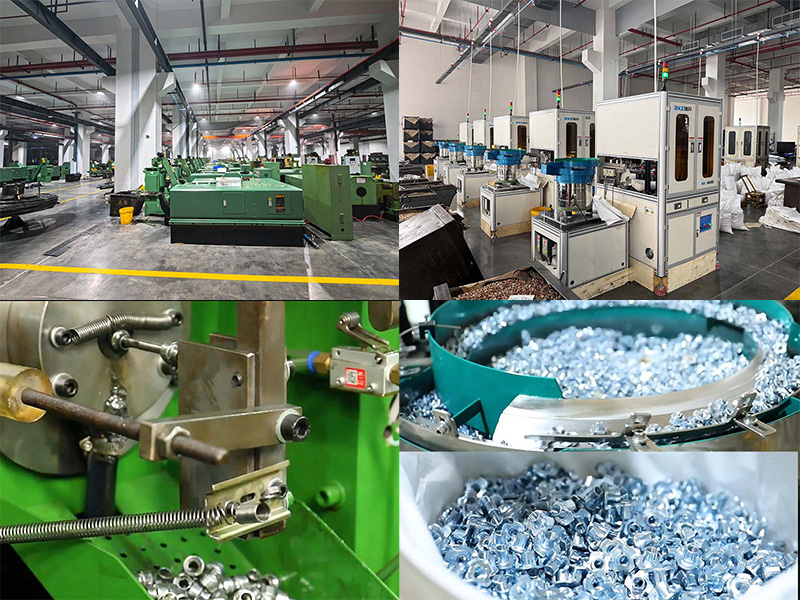
Xinchi Fastener Factory
With a modern production base covering 30,000 square meters and two six-story factory buildings, Xinchi has strong large-scale manufacturing capability. As a trusted fastener supplier, we offer DIN1624 T-nuts, Hopper Feed T Nut, screws, bolts, rivets, and washers, etc. Combined with strict quality control and years of industry experience, Xinchi provides stable and reliable fastening solutions for global customers.