

Common Types of Bolts: Names, Standards, Materials, and Applications
Bolts are essential components in mechanical engineering, construction, furniture manufacturing, and countless industrial fields. They provide the fundamental function of fastening and load-bearing, ensuring the stability and safety of structures and equipment. Understanding the differences among bolt types—including their standards, materials, and typical applications—helps users make the right selection and improve overall performance.
As a professional rivet nut supplier, Xinchi is pleased to introduce the common types of bolts.
Carriage Bolts: Stable Fastening for Wood and Furniture Structures
Carriage bolts, easily recognized by their round head and square neck, prevent rotation during installation and are widely used in wood structures, furniture assembly, fencing, and outdoor applications. Standards include DIN 603 and ANSI B18.5, and common materials are carbon steel, zinc-plated steel, and stainless steel. The unique design of carriage bolts ensures secure fastening while protecting the wooden surface from damage.

Hex Bolts: Universal Fasteners for Mechanical and Structural Use
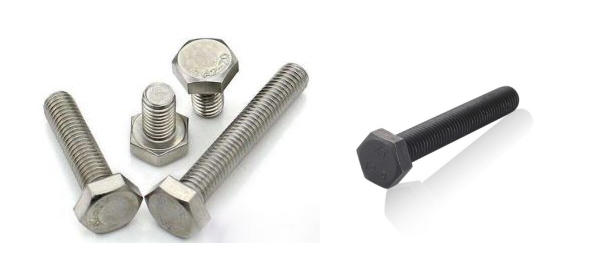
Hex bolts are among the most widely used fasteners due to their hexagon-shaped heads, which allow easy installation with standard wrenches or sockets. They follow major international standards such as ISO 4014/4017, DIN 931/933, and GB/T 5780/5783. And hex bolts are commonly made from carbon steel, alloy steel, or stainless steel. From industrial machines to steel structures, hex bolts offer reliable and strong fastening performance in a wide range of applications.
Socket Head Cap Bolts: Precision Fastening for Compact Spaces
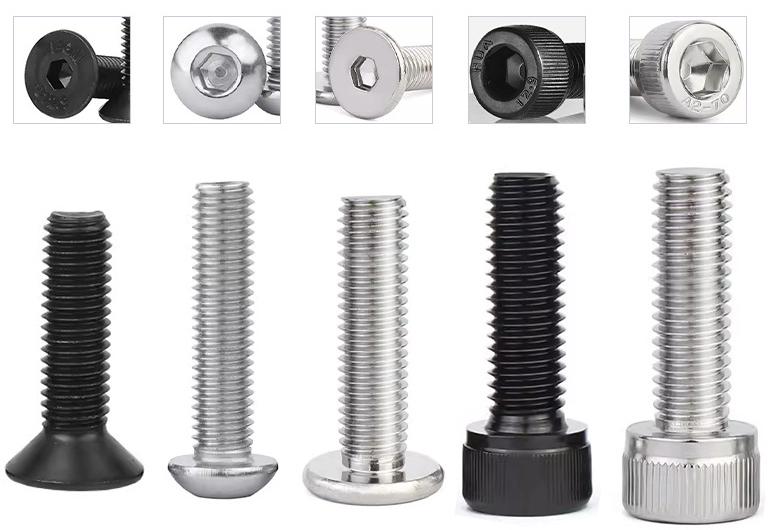
When equipment requires a compact solution or precise assembly, socket head cap bolts become the preferred option. With a cylindrical head and an internal hex drive, they are ideal for machinery, molds, automation equipment, and furniture installation. These hex socket bolts are typically produced according to ISO 4762, DIN 912, and GB/T 70.1. Their material options—hardened alloy steel, carbon steel, and stainless steel—ensure a balance of strength, durability, and installation convenience.
Expansion Bolts: Safe Anchoring for Concrete and Heavy Loads
Expansion bolts are designed for anchoring heavy equipment or structural components into concrete, brick, and masonry materials. By expanding in the drilled hole, they provide a strong holding force and mechanical stability. Expansion bolts follow standards such as DIN 7269 and local GB specifications, and are manufactured in carbon steel or stainless steel. They are essential in construction projects, building reinforcement, and the installation of large machinery.
High-Strength Bolts: Critical Fasteners for Heavy-Duty Engineering
For steel structure buildings, bridges, and high-load mechanical systems, high-strength bolts play an indispensable role. Made from alloy steel and heat-treated for superior performance, these bolts comply with ASTM A325/A490, ISO 898-1, and GB/T 3098.1. Whether subjected to tensile or shear forces, high-strength bolts ensure long-term stability and safety, making them vital components in demanding engineering applications.
Fully Threaded Bolts: Adjustable and Versatile Fastening for Machinery
Fully threaded bolts (also called threaded rods or stud bolts) offer excellent adjustability due to their full-length threads. They are commonly used with nuts for machinery assembly, mold fixation, flange connections, and construction reinforcement. These bolts meet standards such as DIN 975 and various ISO/GB specifications, and are made from carbon steel or stainless steel. Their flexibility makes them suitable for both industrial and construction projects.
Square Head Bolts: Traditional Design with Enhanced Grip
Square head bolts, known for their four-sided head design, provide superior grip and prevent tool slippage during installation. They are often used in older machinery, trains, woodworking, and restoration projects. These bolts follow DIN 579 and certain GB standards and are available in carbon steel and zinc-plated steel. Although classic in design, they remain practical and widely used today.
Choosing the Right Material for Bolts
Bolt performance depends heavily on the material.
- Carbon steel bolts are economical and suitable for general mechanical and construction use.
- Alloy steel bolts are ideal for high-load applications requiring exceptional strength.
- Stainless steel bolts offer corrosion resistance for outdoor or humid environments.
- Zinc-plated bolts balance cost and anti-rust performance.
Selecting the proper material based on working conditions ensures long-term safety and reliability.
Why Choose Xinchi Fastener Factory?
Xinchi is a trustworthy fastener company, especially in furniture nuts. We have a factory, founded in 2007. We are the designated fastener supplier to“STAPLE”. Xinchi Fastener Factory provides a full range of bolts—including hex bolts, socket bolts, carriage bolts, fully threaded bolts, and custom fastener solutions—with stable quality and competitive pricing. Supported by 102 cold heading machines, a daily production capacity of over 10 million pieces, and a new 30,000 m² factory with two 6-story buildings,

As a trusted fastener supplier, Xinchi offers a wide range of high-quality fasteners, including nuts, screws, bolts, rivets, and washers. Xinchi ensures efficient manufacturing, reliable supply, and fast delivery. Combined with strict quality control and professional service, we offer dependable bolt solutions for global customers. If you would like to learn more about fasteners or are interested in wholesale fasteners, please do not hesitate to contact us. Our experienced and expert service team will reply as soon as possible.