

Hex Drive Threaded Insert Nuts vs. 4-Prong T-Nuts: What’s the Difference?
Hex drive threaded insert nuts and 4-prong T-nuts are both used to add threads to wooden panels and other materials. They are often found in furniture and similar assemblies, but their designs and installation methods are quite different.
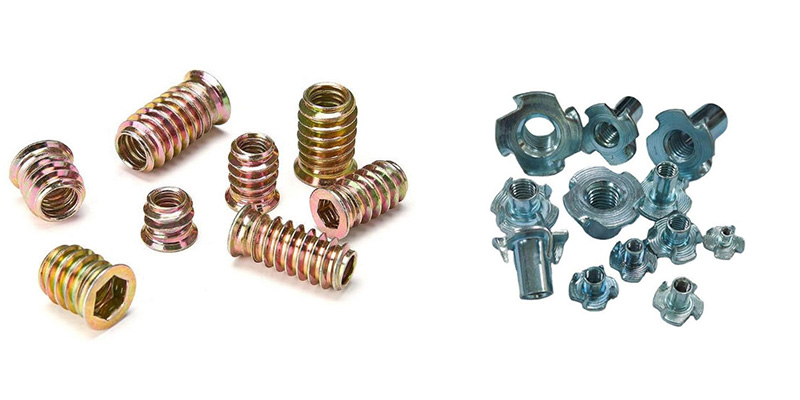
Hex Drive Threaded Insert Nuts vs. 4-Prong T-Nuts
What Are Hex Drive Threaded Insert Nuts?
Hex drive threaded insert nuts have internal threads, external threads, and a hexagonal socket at the top. The socket allows them to be screwed into a pre-drilled hole using an Allen key or hex tool.
The external threads grip the material and hold the insert in place, while the internal threads provide a connection for a bolt or screw.
These inserts are often used in wooden furniture, cabinets, and other products where components may need to be assembled and removed more than once.

Threaded Insert Nut
What Are 4-Prong T-Nuts?
A 4-prong T-nut consists of a threaded barrel and a flat flange with four prongs. The prongs are designed to dig into the material and help keep the nut from rotating.
Unlike hex-drive threaded insert nuts, 4-prong T-nuts are normally installed from the back of a panel. They are pushed or hammered into a pre-drilled hole until the prongs are seated in the material.
You can commonly find 4-prong T-nuts in wooden furniture, speaker boxes, climbing wall panels, and other wood-based products.
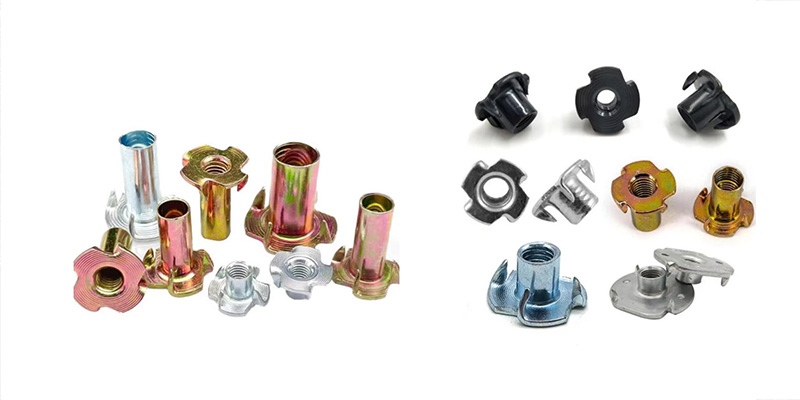
DIN 1624 T-Nuts
Main Differences Between Hex Drive Threaded Insert Nuts and 4-Prong T-Nuts
The main difference is how the two fasteners are installed and held in place.
Structure: Hex drive threaded insert nuts have external threads and a hex socket. 4-prong T-nuts have four prongs around the flange.
Installation: Hex drive inserts are screwed into pre-drilled holes with a hex tool, while 4-prong T-nuts are usually pressed or hammered into the back of a panel.
Holding method: The external threads of an insert grip the material. The prongs of a T-nut help prevent it from turning.
Installation access: Hex drive inserts can generally be installed from one side. 4-prong T-nuts usually require access to the back of the panel during installation.
Which Fastener Should You Use?
It comes down to the panel design and how the fastener will be installed.
If you need to install a threaded fastener from one side of a wooden panel, a hex-drive threaded insert nut may be the better option. It is also suitable for furniture that needs to be assembled and disassembled.
If you can access the back of the panel, a 4-prong T-nut is worth considering. Its four prongs help keep the nut in position when a bolt is tightened.
Before ordering, check the thread size, insert dimensions, hole diameter, and panel thickness to make sure the fastener fits your application.
About Xinchi Fastener Factory
Xinchi Fastener Factory was established in 2007 and focuses on fastener manufacturing. Our factory has 102 cold heading machines and a daily production capacity of more than 10 million pieces.
The new factory covers 30,000 square meters and consists of two six-story buildings.

Xinchi Fastener Factory
Xinchi supplies a wide range of fasteners, including T-nuts, threaded insert nuts, Hopper Feed T-nuts, rivet nuts, DIN 571 wood screws, square weld nuts, hex weld nuts, cage nuts, wing nuts, bolts, and washers. Our products are used in furniture manufacturing and various industrial applications.
Recent Comments