

Hopper Feed T Nuts vs. Four-Prong T Nuts
T Nuts are widely used in furniture manufacturing and woodworking. Four-Prong T Nuts are a common choice for fastening wooden parts, while Hopper Feed T Nuts are designed for use with automatic feeding equipment. Although they serve a similar purpose, their designs and installation methods are different.
Four-Prong T Nuts
Four-Prong T Nuts have a flat flange with four prongs around the edge. The prongs grip the wood when the nut is hammered or pressed into a pre-drilled hole, helping keep it in place during assembly.
They are commonly used in:
- Chairs, tables, and other furniture
- Wooden frames and panels
- Climbing walls
- Other woodworking projects
Four-Prong T Nuts are available in different thread sizes, materials, and surface finishes to suit different applications.
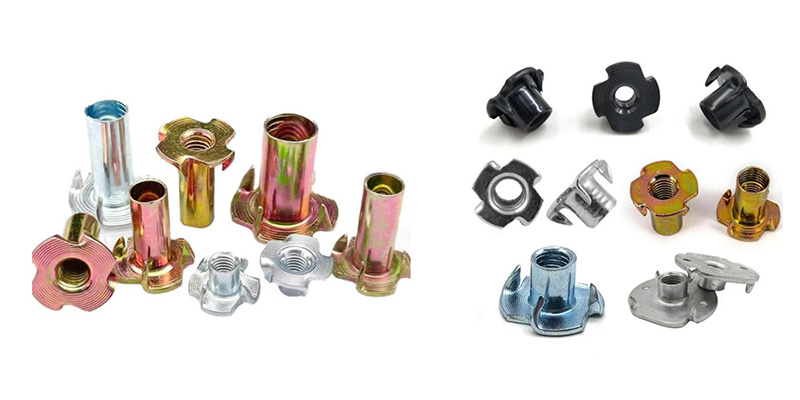
DIN 1624 T-Nuts
Hopper Feed T Nuts
Hopper Feed T Nuts are made for automatic feeding machines used in furniture production. They allow T Nuts to be fed into the installation process continuously, reducing the need for manual placement.
They are mainly used in furniture factories and other production lines where large quantities of T Nuts need to be installed.
Unlike standard Four-Prong T Nuts, Hopper Feed T Nuts may have different flange and barrel designs depending on the feeding equipment. Their dimensions are not necessarily interchangeable between machines.
When ordering, buyers should check the thread size, flange dimensions, barrel size, and overall length. Providing a sample or drawing also helps confirm compatibility with the feeding machine.
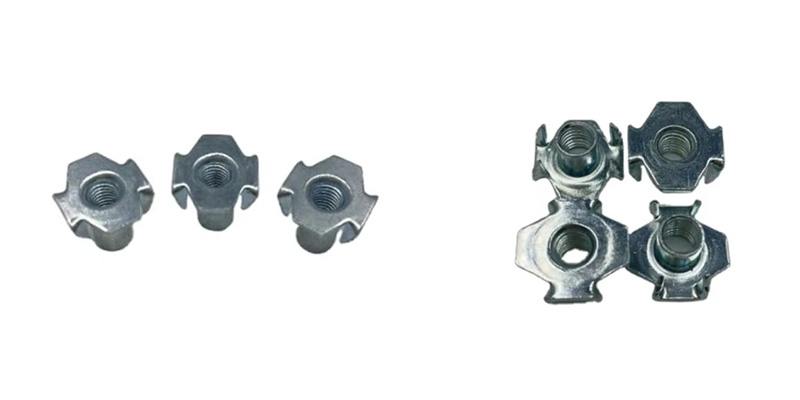
Hopper Feed T Nuts
Hopper Feed T Nuts vs. Four-Prong T Nuts
The main difference between these two types of T Nuts is how they are designed to be installed.
- Structure: Four-Prong T Nuts have four prongs that grip the wood. Hopper Feed T Nuts are designed to work with automatic feeding equipment.
- Installation: Four-Prong T Nuts are generally hammered or pressed into the material. Hopper Feed T Nuts are installed using compatible feeding machines.
- Production: Four-Prong T Nuts are suitable for general furniture assembly, while Hopper Feed T Nuts are used more often in high-volume production.
- Dimensions: Four-Prong T Nuts are commonly ordered by thread and flange dimensions. Hopper Feed T Nuts may require specific dimensions to match the feeding machine.
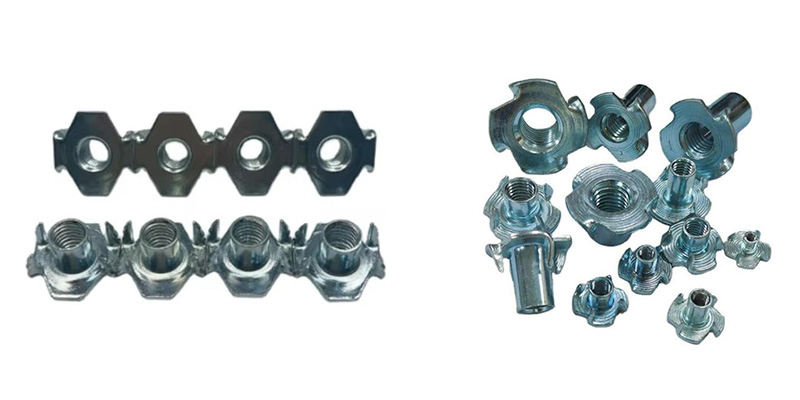
Hopper Feed T Nuts vs. Four-Prong T Nuts
Which T Nut Should You Choose?
For regular furniture assembly or woodworking, Four-Prong T Nuts are a common option. If your production line uses automatic feeding equipment, Hopper Feed T Nuts may be a better fit.
Before placing an order, check the required thread size, material, surface finish, and installation method. For Hopper Feed T Nuts, machine compatibility is particularly important.
T Nut Manufacturing at Xinchi Fastener Factory
Established in 2007, Xinchi Fastener Factory has 102 cold heading machines and a daily production capacity of over 10 million pieces. Our new factory covers 30,000 square meters and consists of two six-story buildings.
We manufacture Four-Prong T Nuts and Hopper Feed T Nuts, along with a wide range of other fasteners, including threaded insert nuts, rivet nuts, DIN 571 wood screws, flange bolts, weld nuts, bolts, and washers for different customer requirements.
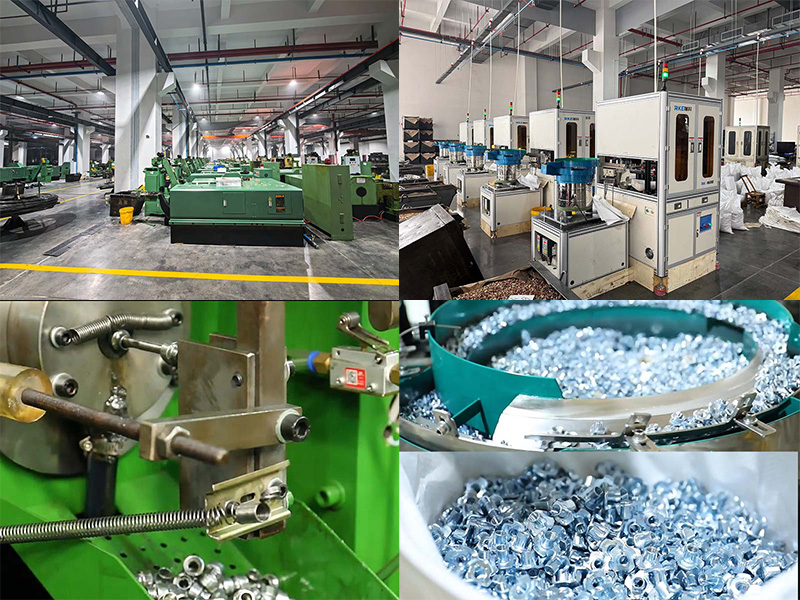
Xinchi Fastener Factory
For T Nut orders, customers can contact us with their required specifications, drawings, or samples. We welcome inquiries for both standard and custom fasteners.
Recent Comments