

Tips on Using Threaded Insert Nut for Strong and Reliable Connections
Threaded insert nuts are small components, but in real manufacturing and assembly work, they often decide whether a joint is stable or fails after repeated use. They are widely used in furniture, woodworking, plastic parts, and light industrial assemblies because they create durable internal threads in soft or low-density materials.
In practice, the performance of a threaded insert nut depends not only on the product itself, but also on how it is selected and installed. As a professional threaded insert nut manufacturer, Xinchi is glad to share some tips on using threaded insert nuts.

Threaded Inserts Nut
What a Threaded Insert Nut Is Used For
A threaded insert nut is designed to reinforce materials that cannot hold threads on their own, such as MDF, softwood, or plastic. Instead of cutting threads directly into the base material, the insert nut creates a metal thread interface inside the part.
This is especially common in furniture production, such as office chairs, cabinets, and modular structures. The biggest advantage is repeatability—products can be assembled and disassembled multiple times without damaging the connection point.
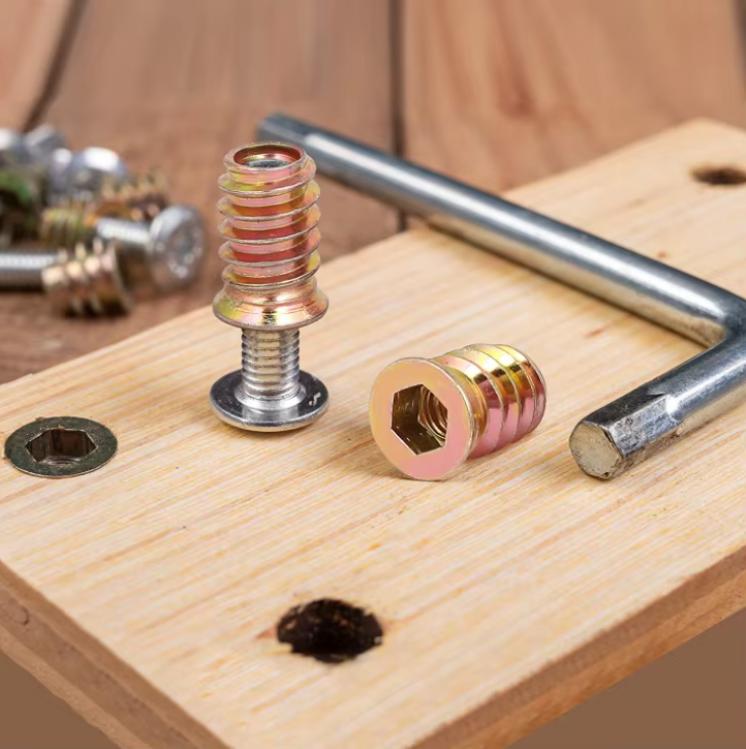
Threaded Inserts Nut for Wood
How to Choose the Right Threaded Insert Nut
In real applications, choosing the right threaded insert nut is more about matching the material than just size.
- Wood applications: coarse external threads provide better grip and prevent loosening over time.
- Plastic parts: sharper or specially designed external profiles help avoid rotation under torque.
- Metal or composite panels: knurled or press-fit types usually perform better under load.
Material selection is also important. Zinc alloy and carbon steel are widely used for indoor furniture, while stainless steel is preferred in environments with moisture or corrosion risk.
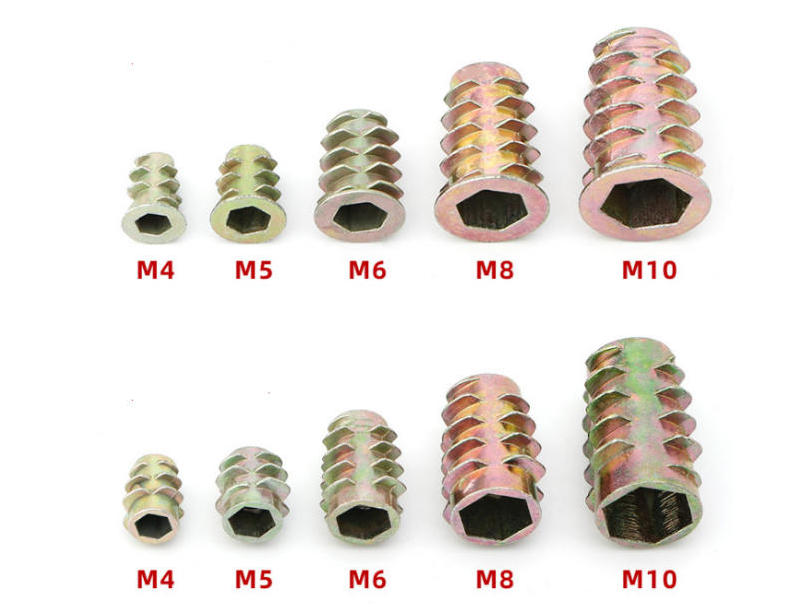
Threaded Inserts Nut
Installation Tips for Threaded Insert Nut
A good threaded insert nut can still fail if installation is not done correctly.
The first key point is hole preparation. The drilled hole must be controlled within a tight tolerance range. If it is too loose, the insert may spin; if it is too tight, it may crack the surrounding material.
In practical production, many manufacturers prefer using a bolt-and-wrench method to pull the insert nut into place instead of hammering it. This keeps alignment stable and reduces stress on the base material.
For mass production, pneumatic tools or dedicated installation equipment help maintain consistency and reduce human error.
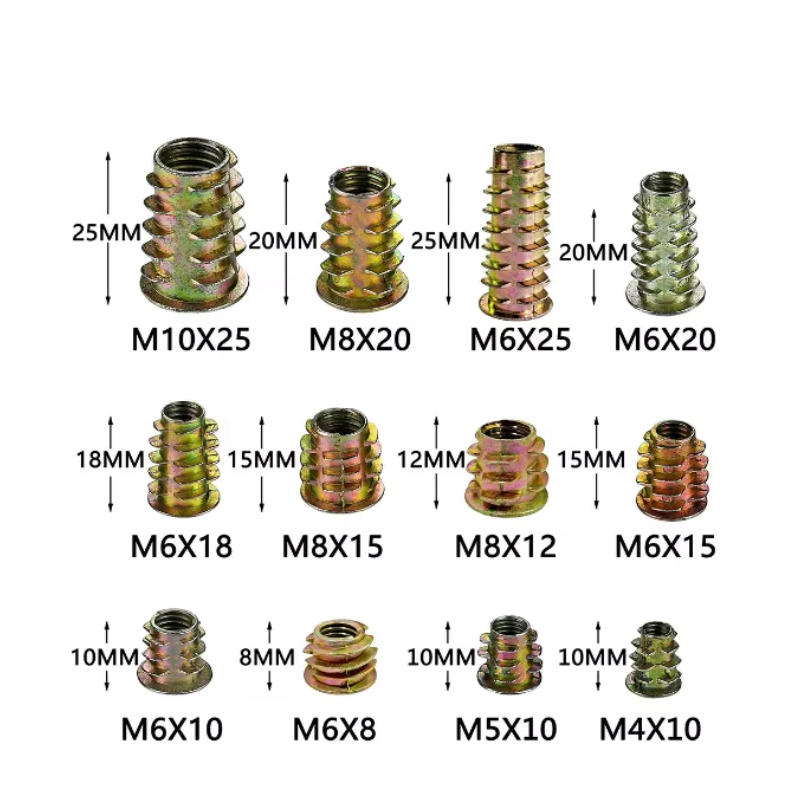
Threaded Inserts Nut
Common Mistakes When Using Threaded Insert Nut
In real factory and assembly environments, failures often come from usage mistakes rather than product quality.
One common issue is over-tightening the screw after installation. Even though the insert nut is metal, the surrounding material is still the weak point and can be crushed.
Another problem is mixing incompatible thread sizes, which leads to cross-threading and early failure.
Reusing damaged threaded insert nuts is also a frequent mistake. Once the internal thread is worn, the connection strength is no longer reliable.
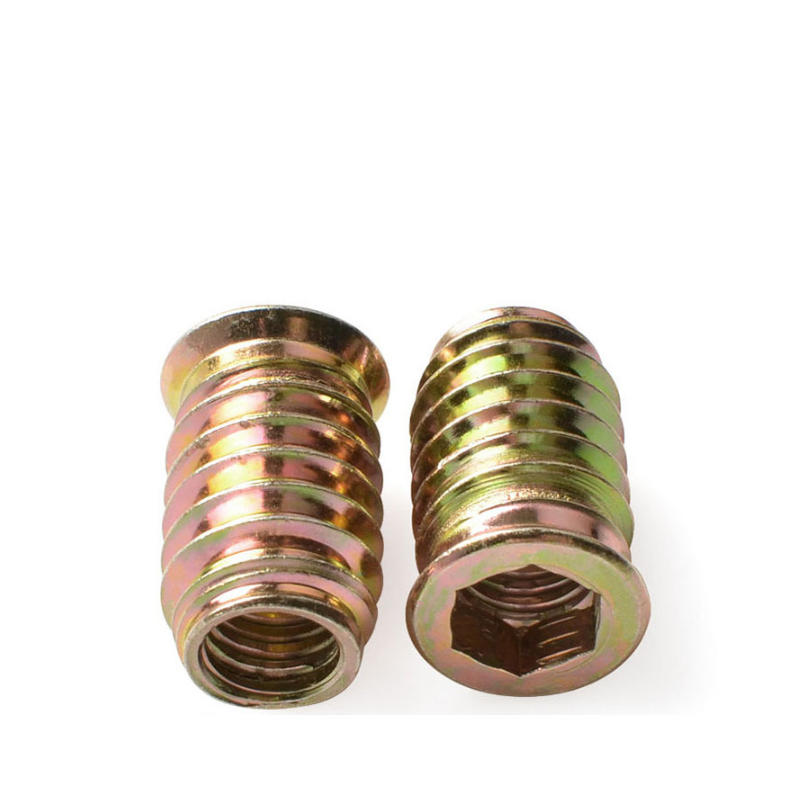
Hex Socket Full Threaded Insert Type D Nut
Typical Applications of Threaded Insert Nut
Threaded insert nuts are widely used in products that require repeated assembly.
In furniture manufacturing, they are commonly found in office chairs, desks, shelving systems, and flat-pack furniture. In industrial applications, they are used in composite panels and equipment housings where metal threading is not possible directly.
Their main value is allowing designers to reduce weight and cost while still maintaining strong mechanical connections.
Long-Term Usage Tips on Using Threaded Insert Nuts
Although threaded insert nuts are generally maintenance-free, regular inspection is still recommended in high-load or vibration environments.
Applying thread-locking compounds can help improve stability in dynamic assemblies. For outdoor or humid environments, stainless steel versions are recommended to prevent corrosion and maintain long-term performance.
About Xinchi Fastener Factory
Xinchi Fastener Factory has been specializing in fastener manufacturing since 2007, including threaded insert nut production for furniture and industrial applications.
The factory is equipped with 102 cold heading machines, supporting stable large-scale production with a daily output exceeding 10 million pieces. This ensures strong supply capability even for high-volume orders. The new manufacturing facility covers 30,000 square meters, consisting of two six-story buildings designed for efficient production flow, quality control, and storage management.
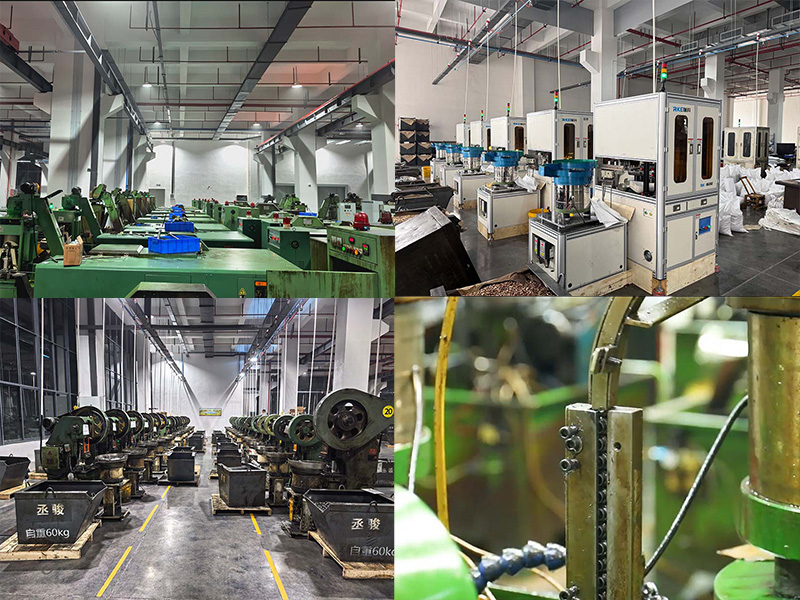
Xinchi Fastener Factory
As a trusted fastener supplier, we can offer a wide range of high-quality fasteners, including nuts, screws, bolts, rivets, and washers. With over a decade of manufacturing experience, Xinchi Fastener Factory provides stable and consistent threaded insert nut solutions for global furniture, construction, and industrial customers.