

What Are the Different Types of Rivet Nuts?
Rivet nuts, also known as blind rivet nuts, are used to add internal threads to sheet metal, tubes, and other materials. They can be installed from one side of the workpiece, making them useful when the back of the material is not accessible.
Rivet nuts come in different designs based on their head type, body type, and end type. These features affect how the insert fits into the installation hole and how it is secured to the workpiece.
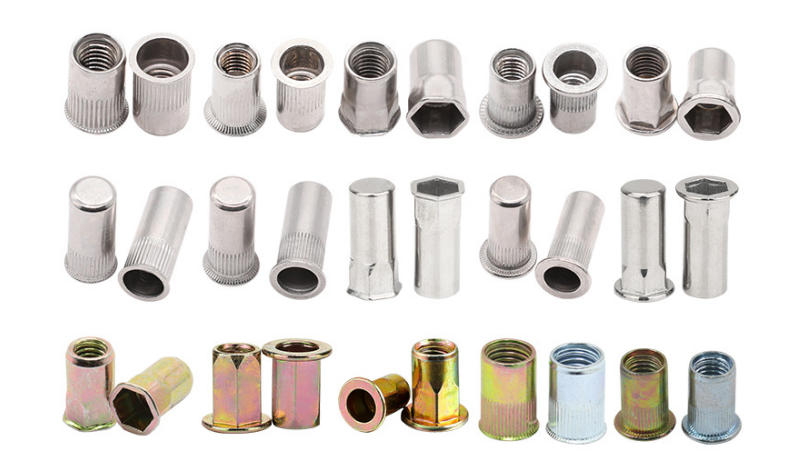
rivet nut
Types of Rivet Nuts by Head Type
The head is the flange at the top of a rivet nut. Its shape and size determine how the insert sits against the workpiece and how much surface area it covers.
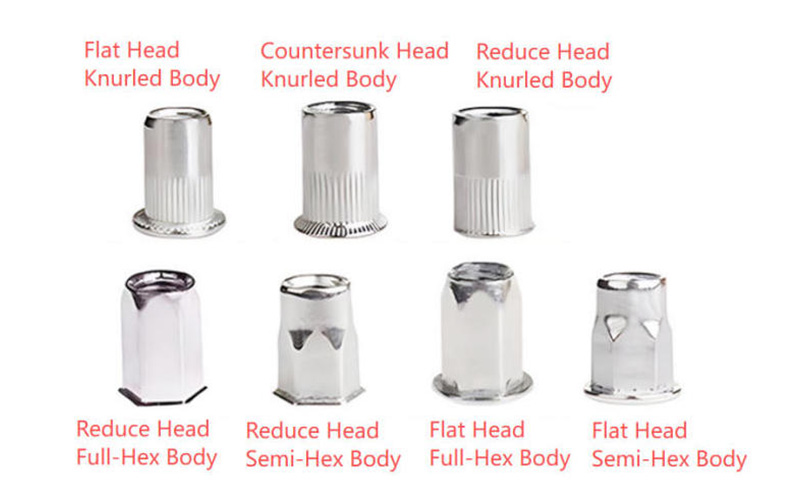
Flat Head Rivet Nuts
Flat head rivet nuts have a flat, relatively wide flange that rests against the surface of the material. They are commonly used in general fastening applications where a flush installation is not required.
Common options include Flat Head Knurled Body Rivet Nut, Flat Head Half Hex Body Rivet Nuts, and Flat Head Full Hex Body Rivet Nuts.
Reduced Head Rivet Nuts
Reduced head rivet nuts have a smaller flange than standard flat head designs. They are suitable for applications where space around the fastening point is limited or a lower-profile head is preferred.
Examples include Reduced Head Knurled Body Rivet Nuts and Reduced Head Full Hex Body Rivet Nuts.
Countersunk Head Rivet Nuts
Countersunk head rivet nuts are designed to sit flush with the workpiece when installed in a matching countersunk hole. The material needs to be prepared with the correct countersink to accommodate the head.
Countersunk Head Knurled Body Rivet Nuts are one example of this design.
rivet nut
Types of Rivet Nuts by Body Type
The body, also called the shank, is the part that fits into the installation hole. Different body shapes provide different contact surfaces and levels of resistance to rotation.

rivet nut
Round Body Rivet Nuts
Round body rivet nuts have a cylindrical outer shape and are designed for round installation holes. They are widely used in general sheet metal fastening.
Knurled Body Rivet Nuts
Knurled body rivet nuts have raised ridges on the outside of the round body. These ridges help improve grip between the rivet nut and the surrounding material, providing additional resistance to rotation after installation.
Flat Head Knurled Body and Reduced Head Knurled Body are common product configurations. Stainless steel and aluminum versions are also available.
Full Hex Body Rivet Nuts
Full hex body rivet nuts have a hexagonal outer profile and are designed for matching hexagonal installation holes. The hexagonal shape helps prevent the rivet nut from rotating after installation.
Both flat head and reduced head versions are available, including stainless steel options.
Half Hex (Semi-Hex) Body Rivet Nuts
Half hex body rivet nuts have a body that is hexagonal on one section and round on the other. This shape provides a non-round contact surface to help resist rotation after installation.
They are also described as Semi-Hex Body or Inner-Hex Body Rivet Nuts in some product catalogs. Flat head and reduced head versions are available, with open-end and closed-end options.
Types of Rivet Nuts by End Type
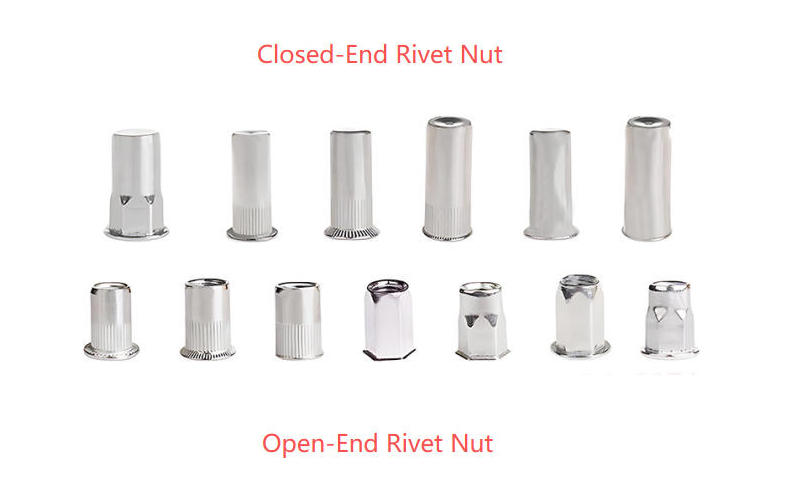
The end type describes the bottom of the rivet nut. The two common designs are open end and closed end.
rivet nut
Open End Rivet Nuts
Open-end rivet nuts have a through-hole, with the internal thread extending through the body. They allow a bolt or screw to pass through the insert and are commonly used in general fastening applications.
Closed End Rivet Nuts
Closed-end rivet nuts have a closed bottom rather than a through-hole. This design prevents the bolt or screw from passing through the end of the insert and helps keep the blind side protected from dirt and debris.
Closed-end designs are available in different head and body configurations, including Flat Head Knurled Body Closed End Rivet Nut and Flat Head Full Hex Body Closed End Rivet Nuts.
A closed end does not automatically make the complete joint waterproof or pressure-tight. Additional sealing may be required depending on the application.
Rivet Nut Materials
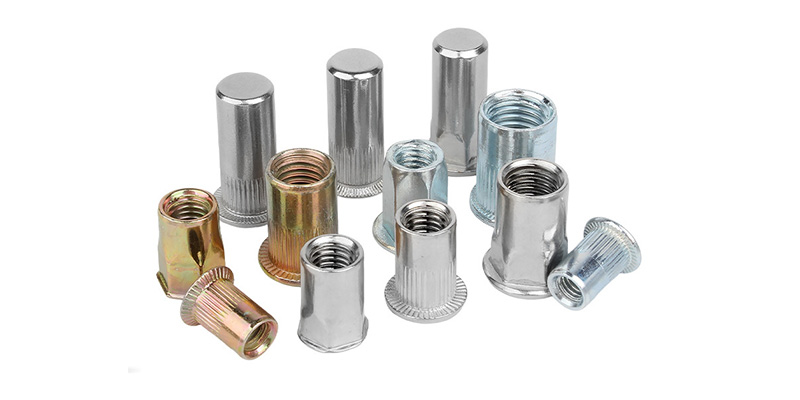
Rivet nuts are available in several materials. The choice depends on the working environment, corrosion requirements, and the materials being joined.
rivet nuts
Carbon Steel: Commonly used for general industrial applications. Zinc plating is a common finish for improving corrosion resistance.
Stainless Steel: Offers better corrosion resistance than ordinary carbon steel and is suitable for applications exposed to moisture or certain corrosive environments. Actual corrosion resistance depends on the material grade and working conditions.
Aluminum: A lightweight option for applications where reducing component weight is important.
The material, thread size, grip range, and installation hole dimensions should all be checked before selecting a rivet nut.
Rivet Nut Manufacturing at Xinchi Fastener Factory
Xinchi Fastener Factory was established in 2007. We have 102 cold heading machines, with a daily production capacity of more than 10 million pieces. Our new factory covers 30,000 square meters and consists of two six-story buildings.
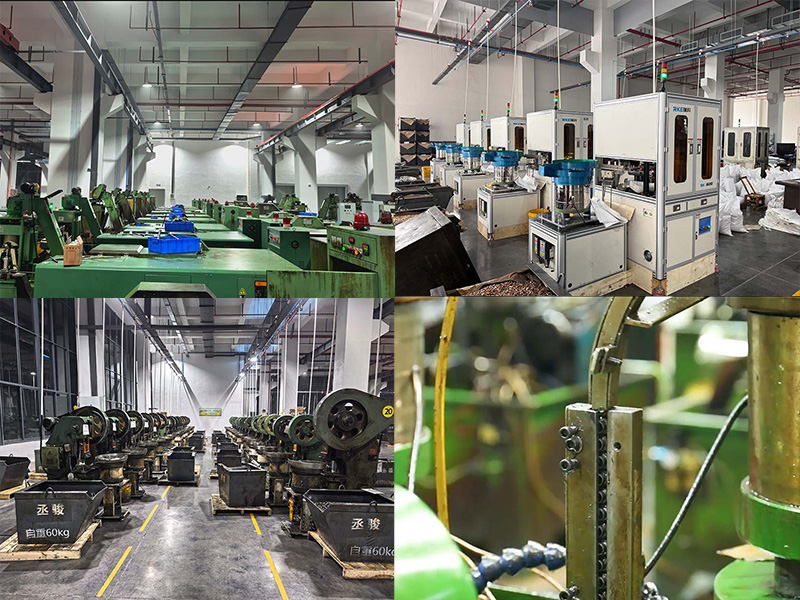
Xinchi Fastener Factory
We manufacture different types of rivet nuts in carbon steel, stainless steel, and aluminum, with various head styles, body shapes, and open-end or closed-end designs. Our product range also includes DIN 1624 T nuts, Hopper Feed T Nuts, threaded insert nuts, square weld nuts, hex weld nuts, and other fasteners for different industrial and furniture applications.
Recent Comments